The underappreciated problem that is key to solving homelessness
By David Amaral, Director of Research and Evaluation
This is the first in a new “Data Spotlight” series of blog posts, where All Home’s research team will dig deep into a topic that is important to our mission. Our goal with this series is to share research-based solutions to overlooked challenges, show how the Bay Area and California are performing, and strengthen the case for effective solutions. We are often frustrated that critical data about homelessness is incomplete or does not give us a full picture. This series focuses on what we can understand better using the data we do have, while acknowledging their limitations.
Key Takeaways
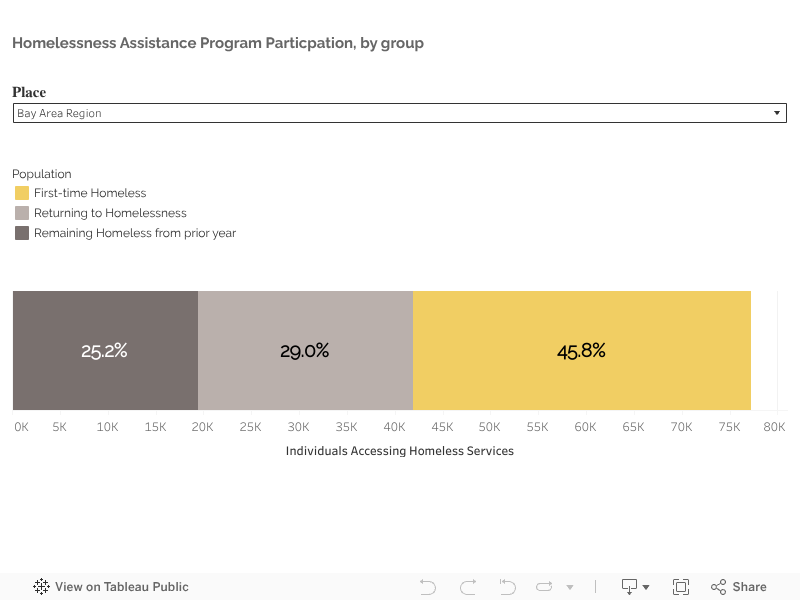
- The homeless population is dynamic, not static—it changes daily as people enter and exit homelessness. In the Bay Area, nearly half of all individuals accessing homelessness services in a given year are experiencing homelessness for the first time. (Jump to the data.)
- The available data leave big gaps in our understanding of who experiences homelessness. For example, new entries into homelessness only capture information about people who enroll in programs. We know very little about all those who don’t enroll in any program or who may have tried to get help, but did not succeed for any number of reasons.
- The “inflow problem” serves as a glaring manifestation of racialized poverty and inequity. Across the Bay Area, Black residents are four times more likely to be pushed into homelessness for the first time, relative to the general population. (Jump to the data.)
- Evidence-based homelessness prevention programs exist, are showing results, and can be scaled to further reduce the number of people pushed into homelessness.
The elephant in the room
Amid the controversy and policy debates ignited by the problem of homelessness, at least one sentiment is broadly shared: we all wish we were solving the problem better and faster. One big reason for what seems like slow progress is that the number of people being pushed into homelessness is outpacing the number of people who move back into housing from homelessness every year. Until we stop or at least reduce new entries into homelessness, we are unlikely to see the results we all want.
This fundamental truth is vastly underappreciated in policy and lawmaking circles, where decisions are made about how to address homelessness and prioritize resources. People are focused on the very visible problem of unsheltered homelessness—and the solution of building more housing. These are, of course, urgent to tackle, but if we don’t reduce entries to homelessness at the same time, we’ll be “tackling” unsheltered homelessness forever.
Homelessness is more dynamic than people realize
Outside of what people observe in their own communities, public understanding of the state of homelessness comes primarily from Point in Time counts, one-night snapshots conducted at least every other year.1 These snapshots show overall increases or decreases in homelessness over time, but can also inadvertently imply that it’s the same people who are homeless over long periods of time.2
The reality is much more dynamic. Thousands of people each year move out of homelessness and into stable housing with assistance from local homelessness response systems.
In the 2023-24 fiscal year, over 17,800 people experiencing homelessness in the Bay Area moved into permanent housing. Statewide, the number was nearly 70,000. 3
But response systems are frequently overwhelmed and underfunded to effectively manage the scale of the number of people in need of housing and services each year.
A snapshot view of homelessness also fails to catch thousands more people who are new to homelessness. People who work in homelessness response often use the term “inflow” to describe people entering the system— Understanding and addressing this inflow is critical to solving the homelessness crisis.
Data on inflow only includes people who’ve touched the homelessness response system
Enrolling in a homelessness assistance program is not the same as becoming homeless, which is a noteworthy limitation of the available data on new entries into homelessness. The data, which come from California’s Homelessness Data Integration System (HDIS) only include those who reside in a shelter, engage with street outreach workers, or receive other forms of housing assistance.4 This means we have no way of knowing how many people become homeless but never engage with a homelessness assistance program.5 This might include a student living in their car for some period of time or a family that is temporarily bouncing between brief hotel stays and staying with relatives without a permanent residence. Sometimes people in such situations do not even realize that they fit the “definition” of experiencing homelessness.
HDIS data indicate the total number of people enrolled in homelessness assistance programs over the course of a year, and of them, how many either:
- had become homeless for the first time,
- returned to homelessness after previously exiting the system to housing, or
- had been enrolled in a support program during the prior year and remained homeless into the current year.
HDIS characterizes people as homeless for the “first time” (even if they have been homeless for a long time or multiple times) only when they finally enroll in a homelessness response system program. Further, based on HUD guidelines, the “homeless for the first time” label is applied to anyone with no prior assistance program enrollment in the previous 24 months. So, someone who stayed in a shelter three years ago could be counted as homeless for the first time if they returned to that shelter today.
Despite these notable flaws, the state HDIS data remain the best available data source for understanding the scale of new incidence of homelessness and making comparisons across counties in the region.6
Entries into homelessness by county
The interactive chart below displays the proportion of all people enrolled in homelessness assistance programs represented by these three categories, for the State of California, the Bay Area region, and the nine counties located within it. Across California, over 190,000 people were characterized as experiencing homelessness for the first time in fiscal year 2023-24. In the Bay Area, this group included over 35,000 people. In each case, this represents nearly half of all people engaging with homelessness assistance programs that year.
Entries into homelessness by race
In order to assess how the prevalence of first-time homelessness varies among different racial and ethnic groups, we compared the HDIS first-time homelessness data disaggregated by race and ethnicity with census data estimating each group’s relative share of the general population.
The bar charts compare the rate of “first-time” homelessness for a particular racial or ethnic group to the percent of the general population that group represents. They reveal that in the Bay Area, Black residents represent 7.6 percent of the general population, but over 32 percent of those becoming homeless for the first time.
We then calculate each group’s rate of “first-time” homelessness per 10,000 residents of that group, an approach frequently used in public health that illustrates risk for people in these demographic groups.7 Looking at the data this way reveals that while the rate of first-time homelessness is 46 per 10,000 Bay Area residents, Black residents in the region are over four times more likely to become homeless for the first time, with a rate of 197 per 10,000 residents. People identifying as Native American/Indigenous or Native Hawaiian/Pacific Islander both experienced first-time homelessness at rates more than two times the region’s general population.

The stark racial disparities in inflow mirror those in homelessness generally. The over-representation of Black and Native American/Indigenous communities among those who experience homelessness—along with the structural and discriminatory causes behind this overrepresentation—has been well-documented in prior research, notably including a recent report from UCSF’s Benioff Homelessness and Housing Initiative.8 Structural forces and racialized policies drive these disparities—people who already face discrimination in housing, employment, education, or the criminal justice system are more likely to be forced into homelessness. Important reports from Los Angeles and Alameda County offer detailed explorations of this problem, and thoughtful solutions. Addressing the inflow problem requires addressing the structural forces yielding racial disparities among those becoming homeless for the first time each year.
Data-Driven Solutions
When we fail to account for the new entries into homelessness problem, we fail to address the phenomenon that perpetuates the problem. There’s no question that we need more housing and housing assistance to solve homelessness. But by focusing narrowly on the new housing needed to expand and expedite exits from homelessness, we’re looking at only one side of the equation. And at current rates of inflow, the amount of new housing needed to make real and rapid progress in reducing homelessness remains both far out of reach and ever-growing.
To make real progress in reducing homelessness in the Bay Area and across the state, we need to do a better job keeping people in their homes, and preventing them from becoming homeless in the first place. In BHHI’s groundbreaking survey of people experiencing homelessness in California, 82 percent reported they believed that a one-time payment of $5,000 to $10,000 could have kept them from becoming homeless.
While the inflow problem remains sorely under-appreciated, targeted homelessness prevention is a program model that has been proven to reduce entries (and re-entries) into homelessness. In Santa Clara County, Destination: Home developed a pioneering homelessness prevention system that—based on findings from a randomized control trial—is both effective at reducing entries into homelessness, and cost-efficient. All Home is helping bring the Santa Clara model to scale by developing a regional infrastructure for targeted homelessness prevention in the Bay Area.
In Los Angeles, the California Policy Lab developed the county’s Homelessness Prevention Unit, which uses predictive modeling to proactively identify and assist households most likely to experience homelessness in the near future. Despite demonstrating proof of concept, targeted prevention programs still lack the necessary funding and scale to achieve the system-level reductions in inflow that they are capable of delivering.
The evidence is clear: we won’t solve homelessness without reducing the growing number of Californians who experience it each year. Achieving meaningful progress will require pursuing policies and budget priorities that account for the dynamic nature of the problem and get ahead of it. Doing so would also spare thousands of Californians from the trauma, loss, and damage that homelessness causes.
ENDNOTES
1 While the U.S. Department of Housing and Urban Development (HUD) requires that point-in-time counts be conducted bi-annually, a number of jurisdictions choose to conduct the counts every year to gather more up-to-date data.
2 Research has identified other limitations of point-in-time counts, including that a significant number of people experiencing unsheltered homelessness are missed by the count, and that one-night snapshots inherently undercount those who experience homelessness for a shorter duration of time.
3 Based on All Home calculations of HDIS data indicating the total people either enrolled in a permanent housing program or who exit to a permanent housing destination over the course of the year.
4 Through a public records request, All Home accessed detailed HDIS system performance measure data from the California Interagency Council on Homelessness (Cal ICH). We focus here on the most recent data from fiscal year 2023-2024.
5 A 2024 survey of unsheltered individuals in Los Angeles found that “about one-half of respondents were not actively engaged with the homelessness outreach system.”
6 First-time homelessness data is also difficult to compare across years since recent legislation has expanded the number of programs required to report into HDIS.
7 A public health framing is particularly appropriate considering the numerous adverse health outcomes associated with experiencing homelessness.
8 For a nationwide study of racial overrepresentation among those experiencing homelessness–including attention to racial bias and discrimination within the homelessness response system–see Olivet et al. 2021.
